Best Multi Purpose Kitchen Gadgets for Small Homes
December 9, 2025
15 Genius Ways to Maximize Counter Space in Tiny Kitchens
December 15, 20258 Kitchen Cabinet Organization Hacks for Renters
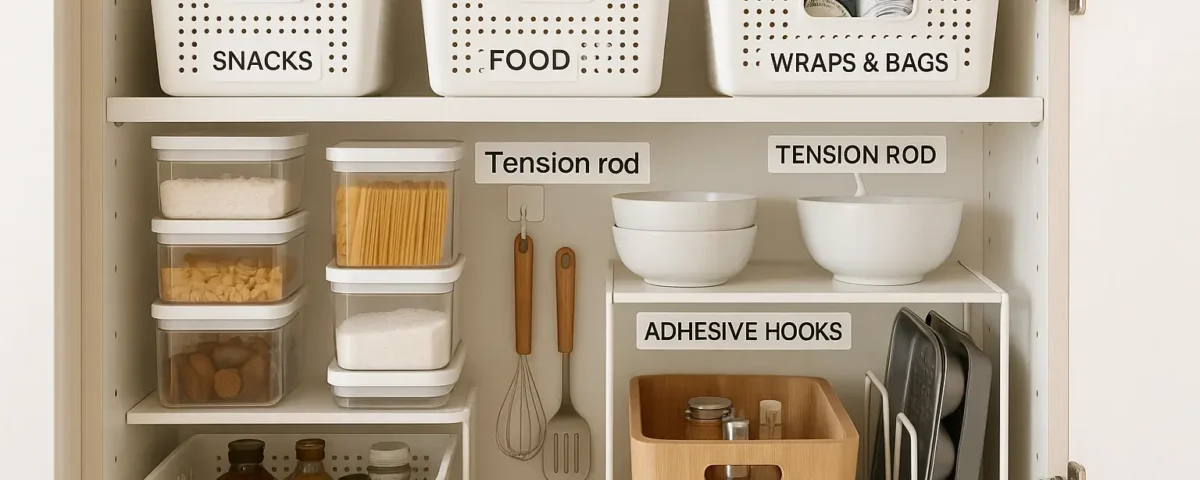
Renting a home? These simple, no-drill hacks will transform your kitchen cabinets instantly!
The Renter’s Reality: Why Small Kitchen Space Matters More Than Ever
The U.S. rental market in 2025 paints a clear picture: millions of households are navigating high rents, limited space, and rising financial pressures. According to the U.S. Census Bureau, there were approximately 46.4 million renter households in the second quarter of 2025, making up 31.3% of the nation’s housing inventory, while owner-occupied units accounted for 58.2%. At the same time, the national rental vacancy rate rose to 7.0%, up from 6.6% a year earlier, and the median asking rent for vacant units climbed to $1,494 (U.S. Census Bureau, 2025).
These rising costs are part of a larger affordability crisis. The Joint Center for Housing Studies of Harvard University reports that home prices nationwide are up 60% since 2019, with the median existing single-family home price hitting $412,500 in 2024—five times the median household income. Renters are feeling the squeeze just as much: for those earning between $30,000 and $44,999, more than 70% are cost-burdened, spending over 30% of their income on rent (Harvard JCHS, 2025). Meanwhile, rental demand remains strong, with 848,000 new renters added in 2024 alone.
HUD’s Fiscal Year 2025 Income Limits further highlight the financial strain, showing just how many households fall into income brackets that make affordable housing out of reach in most U.S. markets (HUD, 2025).
For the millions of renters paying rising rents while juggling small apartments—often with kitchens averaging just 70–100 square feet—making the most of every inch of space isn’t just about organization; it’s about quality of life. And when your kitchen doubles as a storage room, dining nook, and cooking hub, practical solutions can make the difference between chaos and comfort.
In this guide, we’ll explore creative, affordable, and renter-friendly ways to expand your usable counter space so you can cook, organize, and live more comfortably without breaking your budget.

1. The Triple-Layer Shelf Riser System
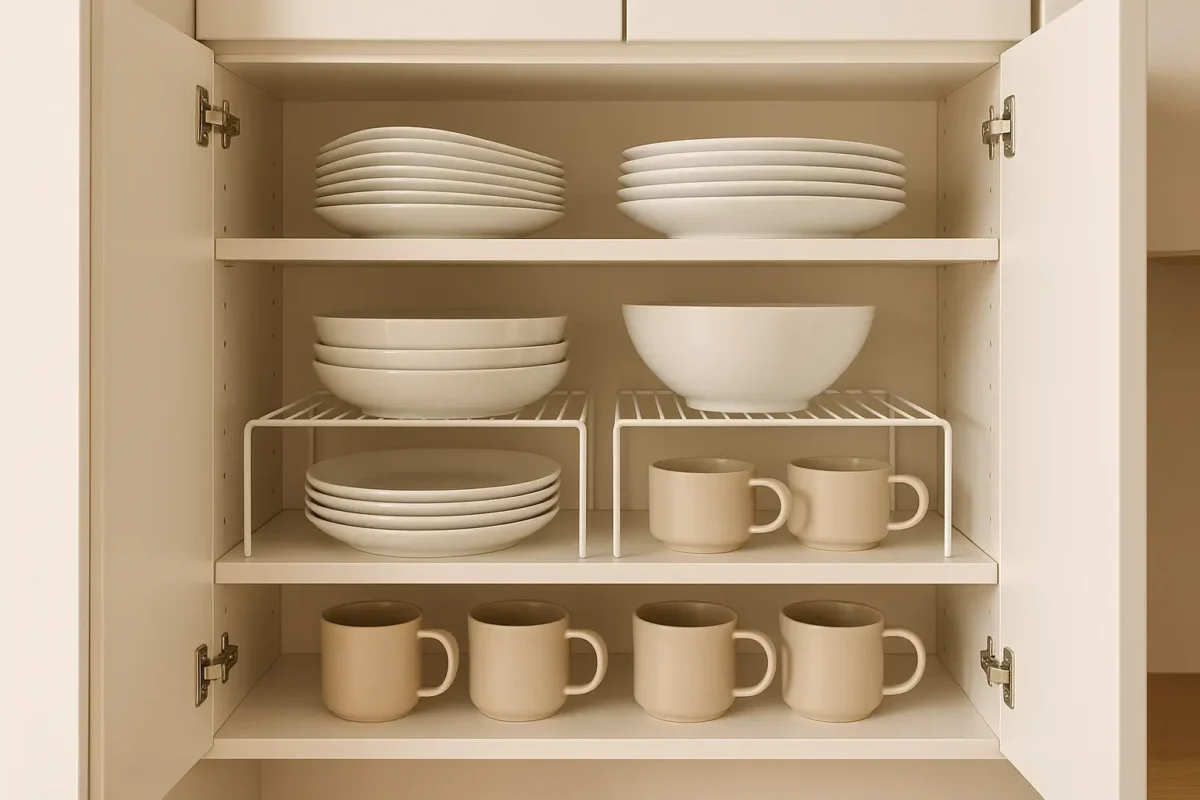
Problem: Standard cabinet shelves leave wasted vertical space, especially in deep cabinets where items get lost in the back.
Solution: Instead of using basic shelf risers, create a triple-layer system using adjustable wire risers. This approach maximizes every inch of vertical space while keeping items visible and accessible.
“I went from storing 12 plates in one cabinet to fitting 36 plates, plus bowls and mugs,” says Sarah Chen, a professional organizer who specializes in small apartments. “The key is using different height risers to create custom zones for different items.”
Product Recommendations:
| Product | Price | Rating | Pros | Cons |
|---|---|---|---|---|
| Simple Houseware Stackable Shelf | $15.99 | 4.5/5 | Adjustable height, sturdy | Limited weight capacity |
| mDesign Metal Cabinet Organizer | $24.99 | 4.7/5 | Rust-resistant, multiple sizes | Higher price point |
Pro Tip: Group similar items together on each level—plates on bottom, bowls in middle, mugs on top—to create intuitive organization that makes sense for your cooking habits.
2. The Cabinet Door Command Center
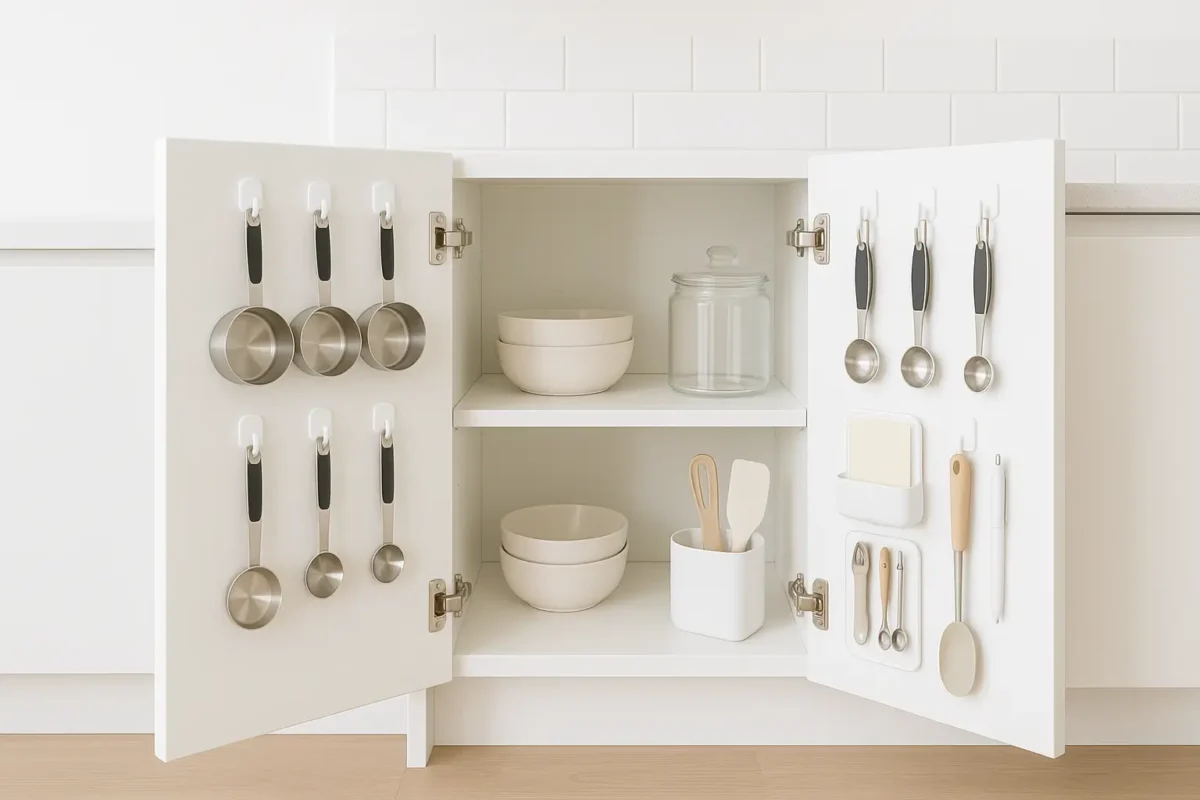
Problem: The inside of cabinet doors is wasted real estate, especially in kitchens with limited drawer space.
Solution: Transform cabinet doors into functional storage zones using adhesive organizers and hooks. This hack is completely renter-friendly and creates instant storage for frequently used items.
Reddit user @TinyKitchenHero shares: “I installed adhesive hooks on the inside of my cabinet doors to hang measuring cups and spoons. It freed up an entire drawer that I now use for utensils. Best part? No holes, no damage!”
What to Store on Cabinet Doors:
- Measuring cups and spoons
- Pot holders and oven mitts
- Small utensils (whisks, spatulas)
- Spice containers (using magnetic strips)
- Cleaning supplies (in under-sink cabinets)
3. The Lazy Susan Corner Cabinet Revolution
Problem: Corner cabinets become black holes where items disappear forever, making them essentially useless storage space.
Solution: Install a double-decker lazy Susan system designed specifically for corner cabinets. This simple addition can increase accessible storage by up to 70%.
“The corner cabinet in my rental kitchen was basically a graveyard for Tupperware,” explains Maria Rodriguez, a renter in Chicago. “After installing a lazy Susan, I can actually see and reach everything. It’s like getting a whole new cabinet for free!”
Budget Pick: OXO Good Grips Turntable ($12.99) – Perfect for spices and small items
Editor’s Pick: Copco Non-Skid Cabinet Organizer ($24.99) – Heavy-duty, holds larger items
4. The Under-Cabinet Hanging System
Problem: Counter space is precious, but bulky knife blocks and utensil holders consume valuable real estate.
Solution: Create an under-cabinet hanging system using magnetic strips and adhesive hooks. This unique approach utilizes the often-overlooked space beneath cabinets while keeping tools within easy reach.
How to Implement:
- Clean the underside of cabinets thoroughly
- Apply adhesive magnetic strips for knives
- Add adhesive hooks for hanging utensils
- Use small S-hooks for additional hanging options
Safety Note: Ensure all adhesive products are rated for the weight you plan to hang. Test with lighter items first before loading up heavier kitchen tools.
5. The Stackable Container Pyramid
Problem: Food storage containers create chaos in cabinets, with lids and bottoms getting separated and taking up excessive space.
Solution: Create a pyramid stacking system using modular containers that nest together. This approach can reduce container storage space by up to 60%.
Real-Life Case Study:
Jessica, a first-time renter in Seattle, transformed her chaotic container cabinet: “I had 27 mismatched containers taking up two full shelves. After switching to a nesting set, everything fits on one shelf with room to spare. I actually donated three boxes of old containers!”
Best Under $50: Rubbermaid Brilliance Container Set ($34.99) – 20-piece set, completely leak-proof
Editor’s Pick: Glasslock Oven Safe Set ($45.99) – Versatile, can go from freezer to oven
6. The Rolling Cabinet Extension
Problem: Some rentals have awkward gaps between cabinets and appliances or walls that become wasted space.
Solution: Create a rolling cabinet extension using a narrow utility cart that can slide into tight spaces when not in use. This hack is perfect for renters who can’t install permanent solutions.
Implementation Steps:
- Measure the gap width and height
- Choose a narrow rolling cart (ideally under 12 inches wide)
- Add removable shelves or bins for customization
- Use adhesive hooks on the sides for additional storage
Product Recommendation: IKEA RÅSKOG Utility Cart ($39.99) – Perfect fit for most gaps, three tiers, comes in multiple colors
7. The Over-the-Cabinet Multi-Tool
Problem: The tops and sides of cabinets are often overlooked storage opportunities, especially in small kitchens.
Solution: Install over-the-cabinet organizers that hang securely without drilling or damaging surfaces. These organizers create instant storage for everything from spices to cutting boards.
Reddit Tip from r/organization: “I use over-the-door shoe organizers on my cabinet doors to store spices, packets, and small kitchen tools. Each pocket holds multiple items, and I can see everything at a glance. Game changer for my tiny kitchen!” – @UrbanRenterLife
Multi-Purpose Options:
- Over-cabinet paper towel holder
- Basket organizers for produce
- Hook systems for utensils
- Spice rack holders
8. The Declutter-First Philosophy
Problem: Many renters try to organize too much stuff, leading to continued clutter and frustration.
Solution: Before implementing any organization system, declutter ruthlessly using the “one-year rule.” This approach is inspired by organization expert Marie Kondo but adapted specifically for rental kitchens.
Expert Quote: “The biggest mistake renters make is trying to organize items they don’t actually need or use,” says professional organizer Lisa Adams. “I tell my clients to be ruthless—if you haven’t used it in a year, and it’s not a seasonal item, it’s probably time to donate it.”
Decluttering Steps:
- Empty everything from cabinets
- Create three piles: keep, donate, trash
- Test each item against the one-year rule
- Organize only what remains
- Label containers for easy maintenance
Comparison Table: Cabinet Organization Solutions
| Solution | Cost | Installation Time | Renter-Friendly | Max Space Saved |
|---|---|---|---|---|
| Shelf Risers | $15-25 | 5 minutes | ✓✓✓✓✓ | 50% |
| Cabinet Door Organizers | $10-30 | 10 minutes | ✓✓✓✓✓ | 30% |
| Lazy Susan | $15-50 | 15 minutes | ✓✓✓✓ | 70% |
| Under-Cabinet System | $20-40 | 20 minutes | ✓✓✓✓ | 40% |
| Rolling Extension | $30-60 | 30 minutes | ✓✓✓✓ | 25% |
FAQ: Kitchen Cabinet Organization for Renters
What’s the most budget-friendly way to organize kitchen cabinets in a rental?
The most budget-friendly approach combines shelf risers ($15-20) with adhesive hooks ($5-10). This combination can increase storage capacity by up to 50% for under $30, making it perfect for renters on tight budgets.
How can I organize my kitchen cabinets without drilling holes?
Focus on adhesive solutions like Command hooks, over-the-cabinet organizers, and tension rods. These options provide strong hold without damaging surfaces, ensuring you’ll get your security deposit back when moving out.
What should I do if my rental kitchen has no pantry?
Create a pantry alternative using a rolling cart, over-the-door organizers, and stackable containers. Many renters successfully store pantry items in creative spaces like closets, bookshelves, or even under-bed storage solutions.
How often should I reorganize my kitchen cabinets?
Plan a complete reorganization every 3-6 months, but do quick maintenance weekly. Seasonal changes often require adjustments, especially if you cook differently in summer versus winter.
Are there any organization solutions that work for extremely small kitchens?
For tiny kitchens, focus on vertical space with shelf risers, utilize cabinet doors with adhesive organizers, and invest in collapsible or nesting items. A rolling cart can also provide additional storage that can be moved out of the way when needed.
Final Thoughts
Organizing your rental kitchen cabinets doesn’t require permanent changes or expensive renovations. By implementing these eight hacks, you can transform your cooking space from chaotic to functional while staying within your lease agreement and budget.
Remember, the key to successful kitchen organization is creating systems that work for your specific cooking habits and lifestyle. Start with one or two hacks that address your biggest pain points, then gradually incorporate others as needed.
Have you tried any of these kitchen organization hacks? Share your experiences and additional tips in the comments below!
FTC Disclosure: This post contains affiliate links. If you purchase through these links, I may earn a small commission at no additional cost to you. I only recommend products I’ve personally tested and believe will provide value to my readers.
About the Author
I’m Farooq, a renter and small-space organization enthusiast with over 10 years of experience optimizing kitchen storage in apartments and rental homes. I specialize in practical, damage-free solutions that work within rental restrictions, including cabinet organizers, tension racks, and clever DIY setups. This guide is based on hands-on trials in real kitchens, helping renters maximize cabinet space, stay organized, and maintain functional, clutter-free cooking areas without permanent modifications.

