Bedroom Decor Ideas for Small Spaces
August 3, 2026How to Organize a Small Closet With No Shelves (7 No-Drill Steps)
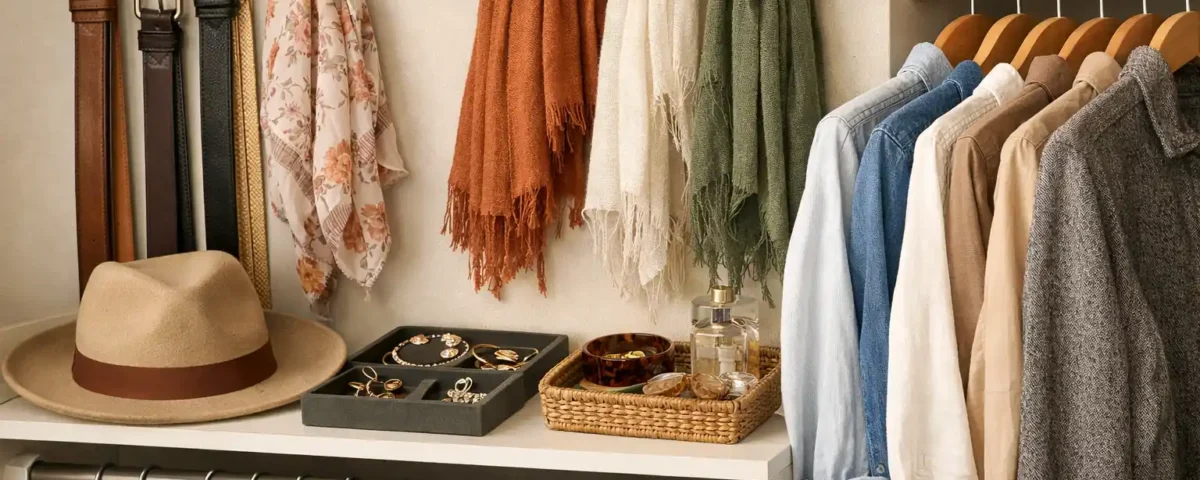
Smart no-drill hacks like tension rods and adhesive hooks unlock hidden storage in renter closets.
This guide is part of our Small Closet Organization hub, where you’ll find every closet guide on Small Space Tips in one place.
Quick answer: A closet with no shelves still has three kinds of space you can use: the rod, the wall height above and below it, and the door. Add a second rod for short clothes, hang a fabric shelf organizer from the existing rod for folded items, put bins or a small drawer unit on the floor, and use the back of the door for shoes and accessories. Most of this needs no drilling and costs less than one built-in shelf.
Affiliate disclosure: Some links below are affiliate links. As an Amazon Associate I earn from qualifying purchases, at no extra cost to you. How we choose products.
Helpful products for this guide
Picked from the problems this guide covers. These are research picks, not tested by us; check sizes against your space before you buy.
SimpleHouseware 6-Shelf Hanging Closet Organizer
Best for: Folded clothes in a closet with only a rod
- Hangs from the rod
- Collapsible fabric shelves
- Side pockets
Watch out: Can sag under heavy denim; load lighter items.
Check price on AmazonResearch pick · we haven’t tested this one ourselvesSimple Houseware Heavy Duty Garment Rack
Best for: Extra hanging space anywhere
- Wheels
- Adjustable height on many
- Quick assembly
Watch out: Cheap racks can bow; check the weight rating.
Check price on AmazonResearch pick · we haven’t tested this one ourselvesOnlyeasy Foldable Underbed Storage Bags
Best for: Seasonal clothes and bedding
- Low profile
- Window to see contents
- Handles
Watch out: Measure bed clearance first.
Check price on AmazonResearch pick · we haven’t tested this one ourselvesSimple Houseware Heavy Duty Garment Rack
BestReviews named Simple Houseware’s heavy-duty rack its best bang for the buck, and TechGearLab included the brand in hands-on testing focused on wobble. Across the category, editors say cheap racks with thin tubes tend to sway once loaded, so the heavier versions with an extendable rod are worth the small extra cost. Expect a metal look and check the height if you plan to roll it through doorways.
Owners praise
- Good value
- Extendable rod
- Rolls on wheels
- Quick to assemble
Owners complain
- Can sway when overloaded
- Industrial look
- Tall racks may not clear door frames
Our research score. Recommended by several reviewers; stability depends on load and model.
Buy it if: your closet is full and you need open hanging space. Skip it if: you want hidden storage; a wardrobe with doors keeps dust off.
Based on owner reviews and expert coverage at BestReviews, TechGearLab. We read these sources in November 2026; we have not tested this product ourselves yet. How we score.
A lot of rentals, older homes and small apartments come with the most basic closet there is: one rod, maybe one high shelf, and a lot of empty air. If yours doesn’t even have the shelf, it can feel like the only option is to cram everything onto hangers and pile the rest on the floor. It isn’t. The trick is to stop thinking about shelves and start thinking about zones.
Step 1: Measure before you buy anything
Write down three numbers: the closet’s width, its depth, and the height from the floor to the ceiling (or to the underside of any existing shelf). They decide which of the ideas below will actually fit.
- Height tells you whether a second rod is possible. HGTV gives 84 inches as the minimum height to hold double hanging rods.
- Depth tells you how deep your floor bins and drawer units can be. Measure from the back wall to the door frame, not to the front of your clothes.
- Width tells you how long a tension or adjustable rod needs to be, and how many hanging organizers fit side by side.
Then take a quick count of what you own: roughly how many long items (dresses, coats), short hanging items (shirts, jackets, folded-over trousers) and foldables (jeans, sweaters, T-shirts). That split is what you’re designing for.
Step 2: Edit first, organize second
Every closet guide says this, and they’re right: nothing makes a small closet work like having less in it. Pull out anything that doesn’t fit, hasn’t been worn in a year, or needs a repair you’ll never get to. Off-season clothes can leave the closet entirely. Our guide to storing seasonal clothes in a small bedroom covers under-bed and vacuum-bag options. If you want a full no-spend system, start with how to organize a small closet without spending money and come back here for the upgrades.
Step 3: Turn one rod into two
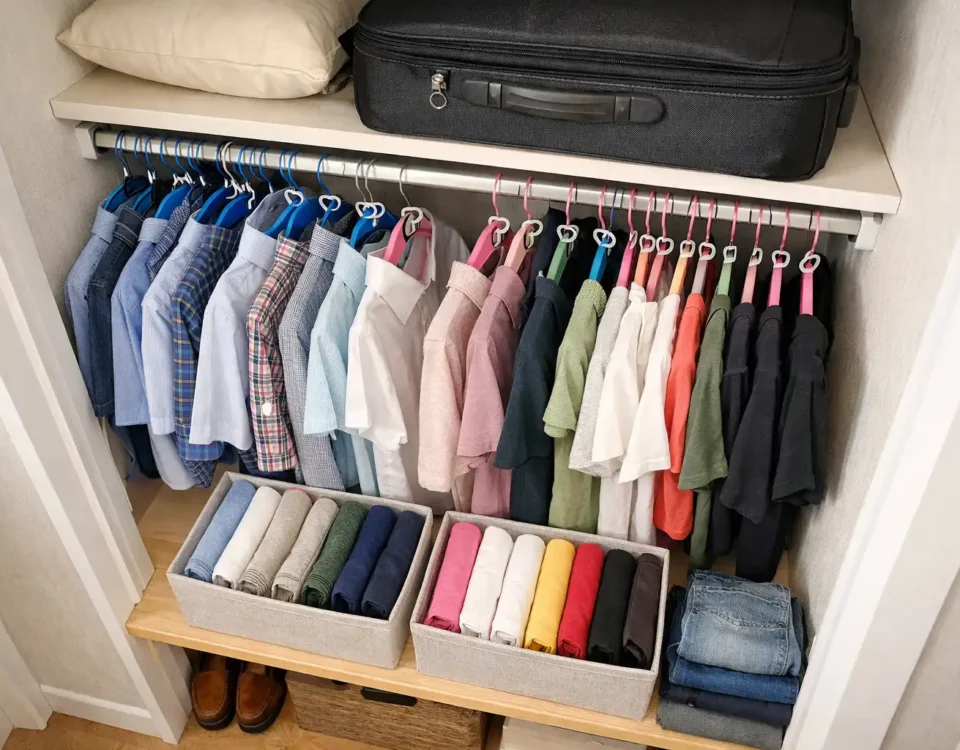
This is the biggest single gain in a shelfless closet. Most of what people hang is short: shirts, blouses, jackets and trousers folded over a hanger. Under them there’s usually two or three feet of empty wall.
Typical guidance from closet installers:
- A single rod is usually set about 66 inches from the floor.
- For double-hang, common heights are about 80 inches for the top rod and 40 inches for the bottom rod. Lowe’s suggests a little higher, about 84 and 42 inches.
- Long items need their own section. Home Depot says dresses need about 60 inches of hanging space and suits about 42 inches.
So a good layout for most closets is double-hang across two-thirds of the width and a single, full-length section for the rest.
No-drill options:
- Hanging closet doubler: a second bar that hooks over your existing rod and hangs below it. Nothing to install, and it comes out in seconds when you move.
- Tension rod: works in narrow closets where both side walls are solid. Keep loads light: tension rods carry less weight than rods fixed with brackets. For example, a 24–40 in. steel tension curtain rod sold at Lowe’s is rated for 25 lb.
- Adjustable bracket-mounted rod: if you can drill (or your landlord allows small screw holes), this is the sturdiest option. A common 48–72 in. adjustable steel rod is rated for about 30 lb, and Lowe’s notes that real capacity depends heavily on the brackets and hardware you use.
Weight check: heavy winter coats and jeans add up fast. If a rod starts to bow, move the heaviest pieces to the main rod or to the single-hang section, and never hang more than the rod’s stated capacity.
Step 4: Hang your “shelves” from the rod
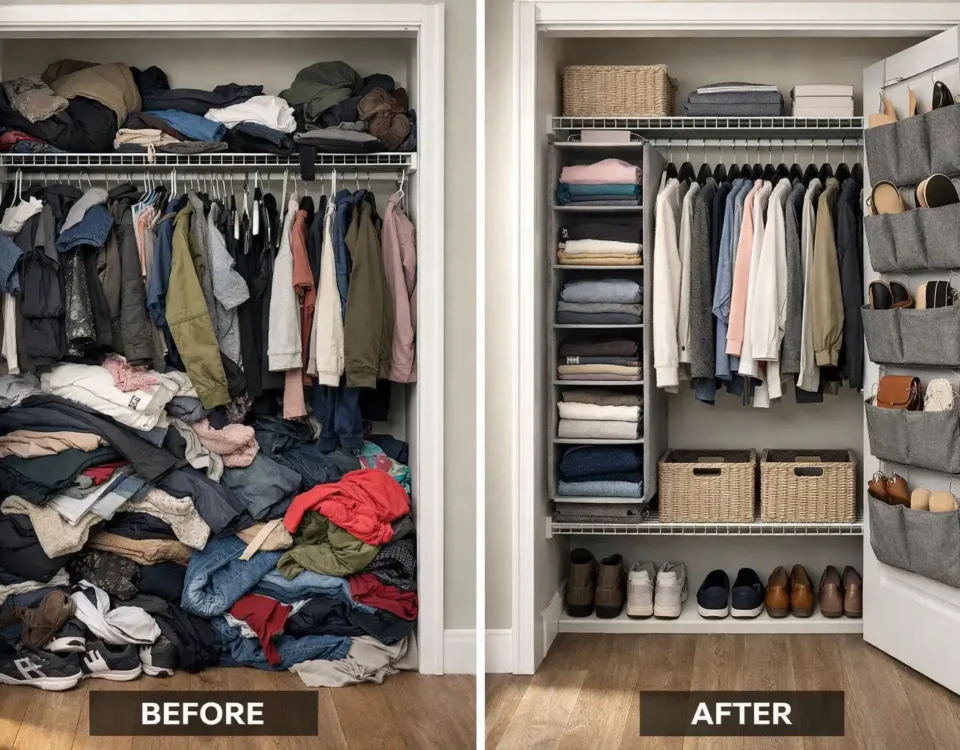
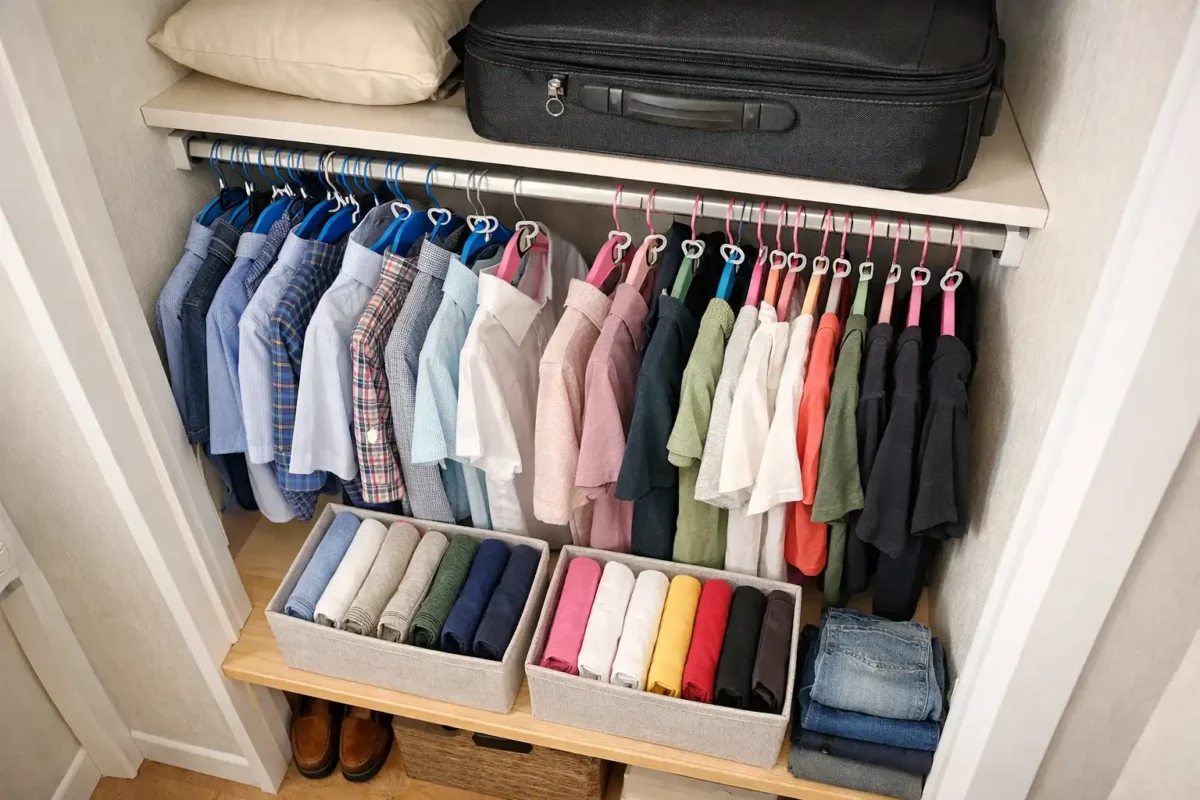
A fabric hanging organizer, the kind with 5 or 6 open cubbies, is the closest thing to a shelf you can add without tools. It loops over the rod with hook-and-loop straps and holds folded sweaters, T-shirts, jeans and bags.
- Choose one with a rigid insert at the bottom of each cubby so it doesn’t sag.
- Keep the heaviest folded items (jeans, hoodies) in the lower cubbies.
- Put the organizer at one end of the rod, so it doesn’t split your hanging space in two.
We compared the popular styles, from 3-shelf to 6-shelf and with or without drawers, in our guide to the best hanging closet organizers for small spaces.
Step 5: Use the floor properly
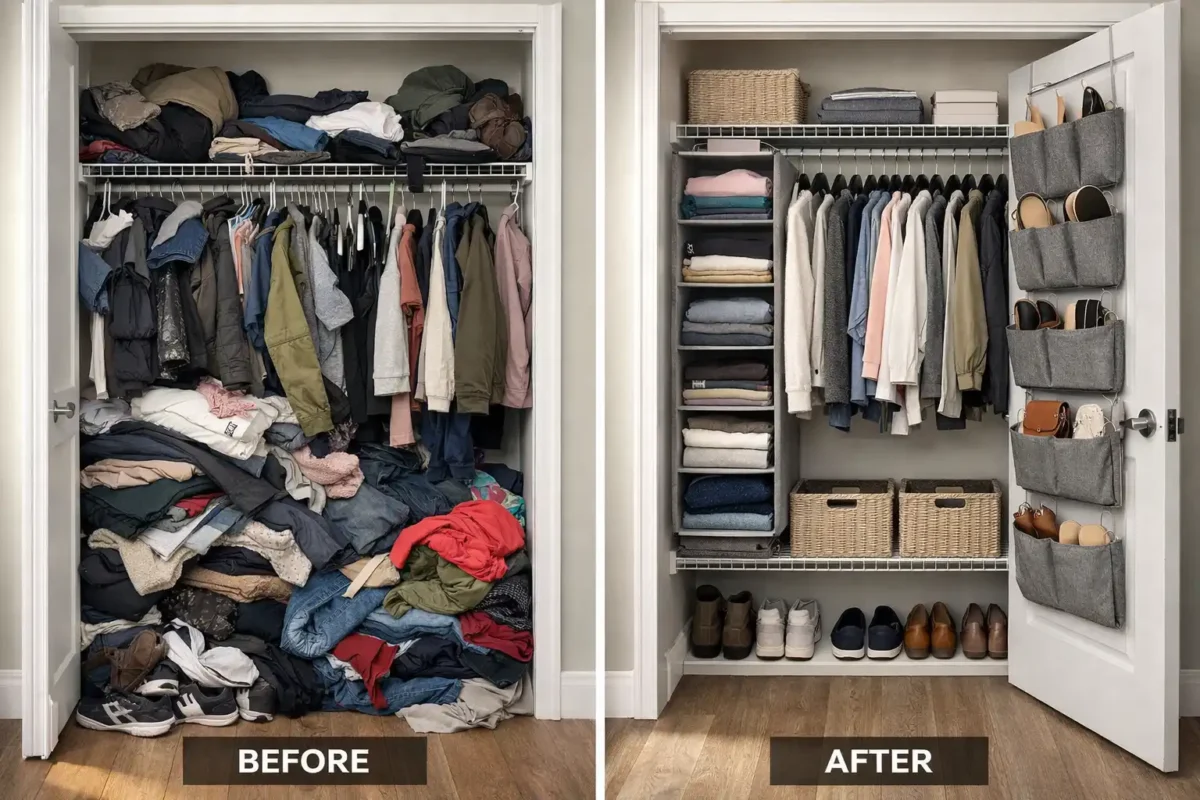
Without shelves, the closet floor does the job a dresser would. The goal is to stack upward in containers, not to pile loose items.
- A slim 3-drawer plastic unit fits under the short-hang section and holds underwear, socks and gym clothes.
- Lidded, stackable bins for things you use less often. Label the front so you don’t have to unstack to find something. Our list of storage bins under $20 has sizes that fit standard closet depths.
- A shoe rack or a row of shoe boxes along the back wall, if your shoes aren’t going on the door.
A useful rule from Home Depot: keep what you use most often at eye level, and put seasonal or rarely used items up high or down low. In a shelfless closet, that means today’s clothes on the rods and the hanging organizer, and spares in the floor bins.
Step 6: Work the door and side walls
The inside of the closet door is the most overlooked storage in a small closet.
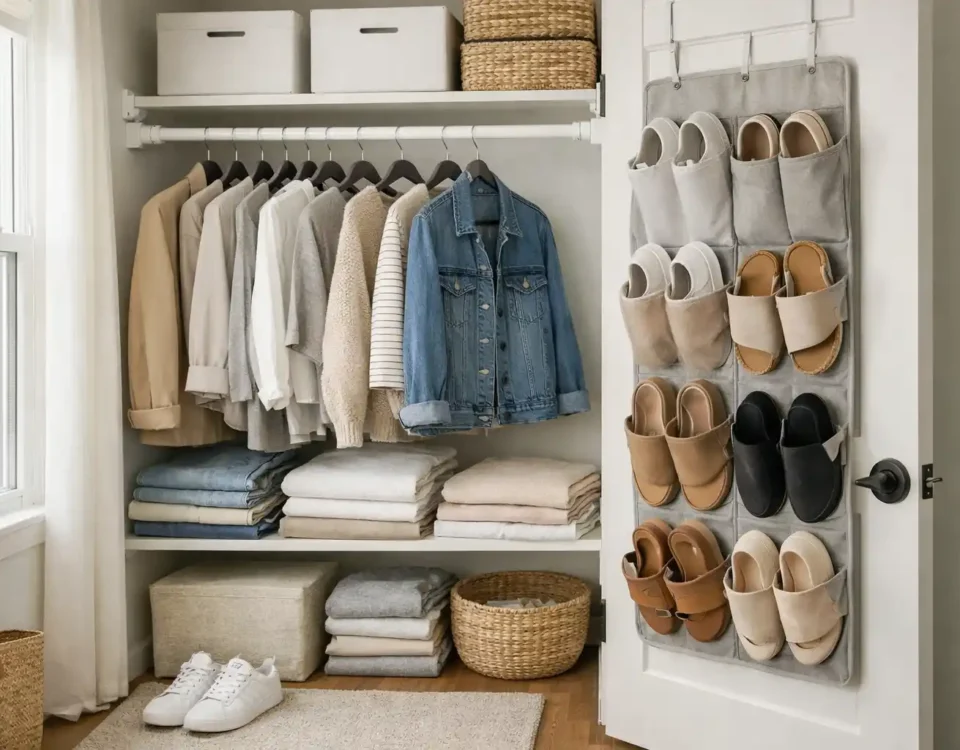
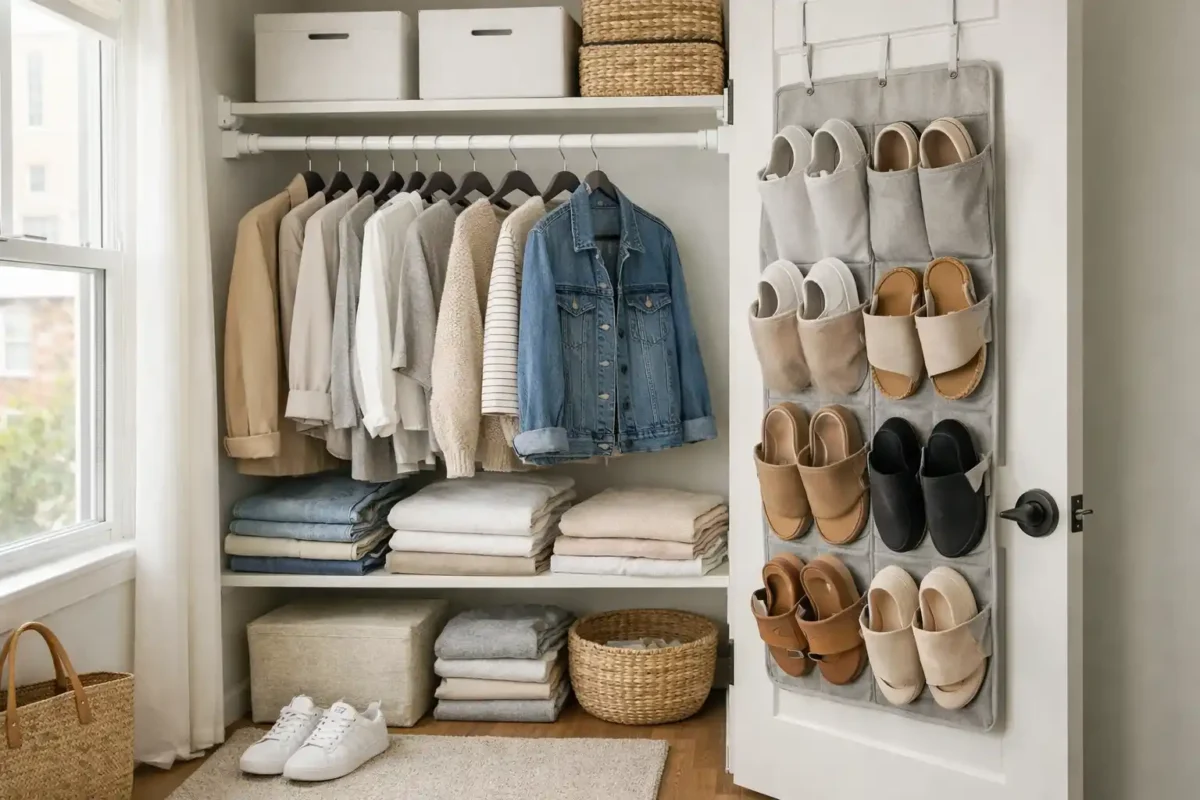
- Over-the-door shoe organizer with clear pockets. It also holds scarves, belts, socks and cleaning supplies.
- Over-the-door hooks for bags, robes and tomorrow’s outfit.
- Adhesive hooks on the side walls for belts, hats and necklaces. Check the weight rating on the pack and press them onto clean, dry paint.
If you have sliding or bifold doors, skip the over-the-door products and use the side walls instead. Our shoe storage hacks for small bedrooms include options that work with any door.
Step 7: Use the space above the rod
If there’s at least a foot of wall between the top rod and the ceiling, you can still add one shelf there, even in a rental. Choices, from easiest to most permanent:
- A freestanding wire shelf or closet tower that stands on the floor and rises above the rod line.
- A tension-mounted shelf for narrow closets. Use it for light items only, like hats or spare bedding.
- A bracket shelf screwed into the studs. If you’re allowed to drill, this is the strongest option. For folded clothes, closet designers usually space shelves about 12 inches apart, which is a good guide if you add more than one.
For a step-by-step plan that stays fully removable when you move out, see our Renter’s Closet Blueprint.
A simple layout for a 4-foot closet with no shelves
As an example, here’s how the pieces above could fit into a common 48-inch reach-in closet. Adjust the widths to your own measurements.
- Left 12 inches: single-hang section for dresses and coats, with a shoe rack on the floor below.
- Middle 24 inches: existing rod with a hanging doubler below it for shirts and trousers. A 3-drawer unit sits on the floor under the lower bar if there’s room.
- Right 12 inches: a 6-cubby hanging fabric organizer for folded clothes, with a lidded bin on the floor below.
- Door: clear over-the-door pocket organizer for shoes and accessories.
- Above the rod: a labeled bin for off-season items, if there’s an existing shelf or a freestanding unit.
Common mistakes to avoid
- Buying organizers before measuring. Hanging organizers and bins come in many depths. A 15-inch-deep bin won’t close properly in a 22-inch closet once clothes hang in front of it.
- Overloading a tension rod. If it slips, it can bring everything down with it. Check the stated weight capacity and keep heavy coats on fixed rods.
- Using bulky hangers. Slim, matching hangers make the same rod hold noticeably more.
- Filling the floor with loose piles. Everything on the floor should be in a bin, drawer or rack. Otherwise the floor turns back into a junk pile within a few weeks.
What if you don’t have a closet at all?
Some of these ideas, like rolling racks, freestanding towers and door storage, work without any closet. We cover that situation in detail in how to organize a bedroom without a closet.
FAQ
How do I add shelves to a closet without drilling?
Use a hanging fabric organizer on the existing rod, a freestanding wire shelf or closet tower, or a stackable drawer unit on the floor. In narrow closets, a tension-mounted shelf works for light items.
What height should a second closet rod be?
Common double-hang heights are about 80 inches for the top rod and 40 inches for the bottom. Some installers use 84 and 42 inches. Check that your shortest-hanging items clear the floor before you fix anything in place.
How much weight can a closet tension rod hold?
It depends on the product, so check the label. As an example, a standard steel tension curtain rod sold at Lowe’s is rated for 25 lb. Bracket-mounted rods are usually stronger, but their real capacity depends on the brackets and on what they’re screwed into.
Where should folded clothes go in a closet with no shelves?
Put them in a hanging cubby organizer on the rod, in a drawer unit on the closet floor, or in labeled bins. Heavy items go lowest.
Sources for the measurements in this guide: HomeGuide (rod heights), Lowe’s (double-rod heights, shelf spacing), HGTV (minimum height for double rods), and Home Depot (hanging lengths, eye-level storage). Product weight ratings come from the retailers’ listings at the time of writing. Always check the label of the product you buy.
Related Small Space Guides
- Small Closet Organization: The Complete Hub
- Renter’s Closet Blueprint: A 5-Phase No-Drill System
- How to Organize a Small Closet Without Spending Money
- Best Hanging Closet Organizers for Small Spaces
- How to Store Seasonal Clothes in a Small Bedroom
- Small Space Organization Hacks: The Master Guide
About the Author
Mehran Azam is the founder of Small Space Tips. He writes practical guides on organizing small apartments, rentals and tiny rooms. Guides are researched from manufacturer specs, retailer measurements and installation guidance, and are updated when products or recommendations change. Read more about how we research and write our guides.